
Organ
Organ music plays a large part in our worship Sunday by Sunday and we are blessed with a wonderful instrument that can produce a magnificent sound for grand occasions and yet lead our mind to higher things for those quiet, reflective moments. The list of recently played music can be found on the pages for this months music.
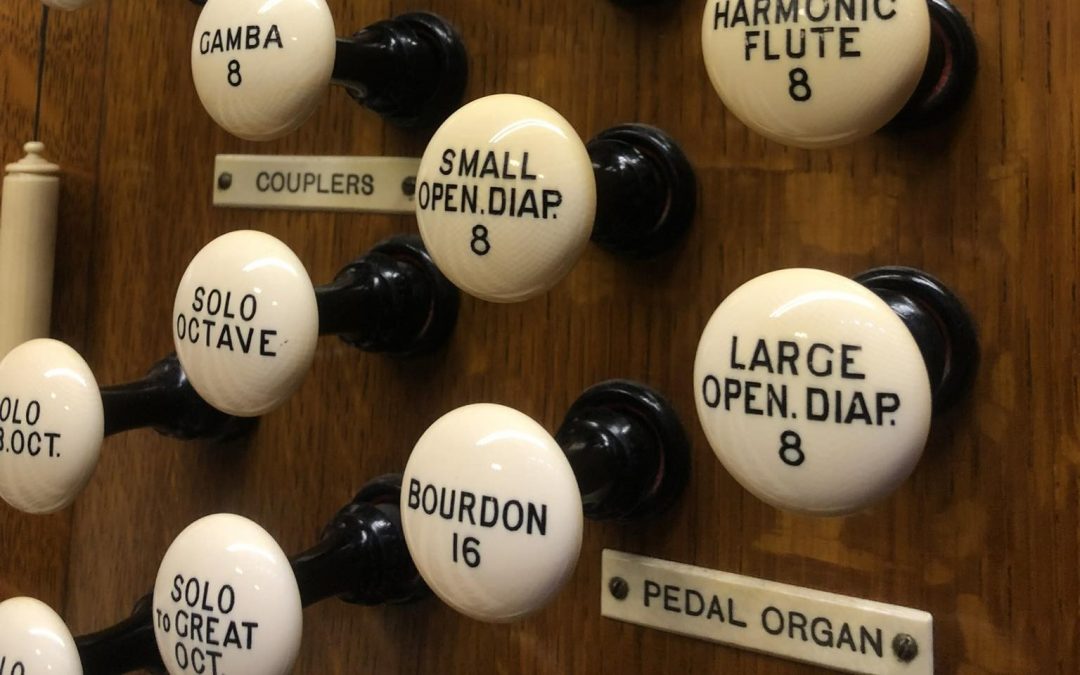
St George's has a very fine four manual instrument which still contributes much to the strong musical tradition of the church. The organ is a 4 manual Lewis & Co with 44 sounding stops and 23 couplers. Some 2675 pipes were used and, in the original instrument, the conducting tubes were said to extend over three miles in length.
History
The organ, the gift of Charles Mitchell, was built by Lewis and Co of London, in 1887 and exhibited at the Newcastle Jubilee Exhibition of that year where it was used for public concerts before being placed in the church.
The organ was originally driven by two Armstrong hydraulic engines situated below the tower, but is now driven electrically. The organ was reconstructed in 1904 by Binns and in 1993 was overhauled and partially rebuilt by Harrison and Harrison of Durham.
The history of the organ is an interesting comment upon the manner in which fashions change and the idea of excellence varies. Binns' reconstruction was thought to be an improvement upon the original by correcting the imperfections of Victorian design. However, the work undertaken recently sought to bring back much of the pipe work and voicing to its original 1887 specification.
James Moody Preston

A consideration of the organ cannot be complete without reference to the first organist, James Moody Preston, whose plaque is situated on the pillar nearest to the organ. Preston was a young man in his early twenties when he gave one of the public organ recitals on Mitchell’s new organ, on show at the Newcastle Jubilee Exhibition, and this was to secure his services as organist of St George’s for the next 43 years (1888 - 1931). There is a framed letter from Charles Mitchell offering Preston the post of organist at the newly built church of St George in Jesmond at the princely sum of £90 per annum.
There is no doubt that Preston was a giant amongst organists in his lifetime, as seen by extant documentation. He gave organ recitals up and down the country and occasionally abroad. One of the first broadcast organ recitals was given by Preston from St Margaret’s Church, Westminster in 1928 at a time when broadcasting was in its infancy. Sadly, the published recital programme is all that exists, as this recital was given long before recordings were made. Nearer to home, Preston gave the opening recital on the new organ installed at the Newcastle City Hall and was also the conductor of the Newcastle and Gateshead Choral Society for many years.
A 1902 article1 on the Newcastle music scene at the turn of the 20th century gives more details on Preston:
"Born at Gateshead, on July 14, 1860, Mr. Preston is a home-grown product. At an early age he studied the violin and pianoforte under his father, Mr. Stephen E. Preston, and when thirteen years old he received some pianoforte lessons from the late Lindsay Sloper, in London.
In 1875, aged 15, Master Preston was appointed organist of St. Joseph's Roman Catholic Church, Gateshead, where he remained for six years, diligently working at the organ. In 1881 he became one of the earliest students of the Guildhall School of Music, then located in a warehouse in Aldermanbury - and studied the organ under the late Sir John Stainer, at that time a professor of the School.
For the rest, Mr. Preston is entirely self-taught; and his position, as one of the most distinguished organists and choir trainers in the North of England, he owes not a little to those precious qualities of self-help and steady perseverance. For five years (1883 - 88) he was organist of St. Thomas's Church, Newcastle; but since 1888 he has held the important post of chief musician at St. George's Church, Jesmond (Newcastle). For several years past, Mr. Preston has given an organ recital in his church every Sunday evening, always with great acceptance; the printed catalogue of the pieces he has played bears remarkable testimony to the catholicity of his taste and the wide range of his sympathies. The City of Newcastle is fortunate in possessing so capable a native born musician as James Moody Preston."
1 The Musical Times and Singing Class Circular, Vol. 43, No. 707 (Jan. 1, 1902), pp. 24-27